

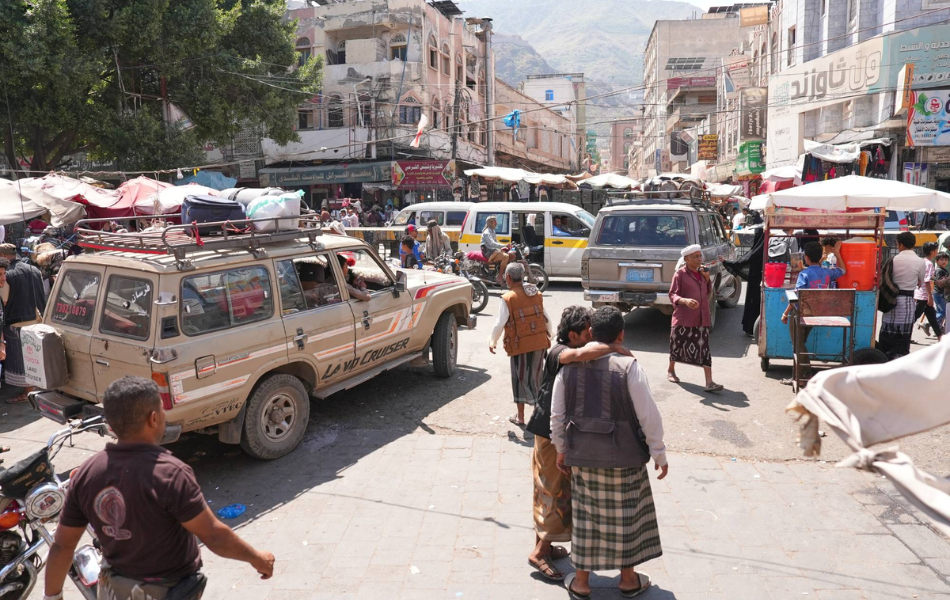
SAM for Rights and Liberties monitored serious human rights and humanitarian developments in Yemen between 15 and 17 October 2026, primarily concentrated in Taiz Governorate, where residential areas in Sabir Al-Mawadim and Maqbanah were subjected to attacks that killed and injured civilians, including women and children. These incidents coincided with increasingly severe restrictions on civilian movement and the delivery of drinking water, food, and medicine, as well as a deterioration in the ability of hospitals and humanitarian facilities to provide essential services.
The reporting period also witnessed missile strikes in the vicinity of Aden International Airport, alongside reports of other attacks in Aden and Lahj. Meanwhile, United Nations agencies warned that displacement had exceeded 233,000 people, health and food security conditions were deteriorating, and health care and protection services were being disrupted, particularly for children, women, and girls.
This briefing draws on information obtained by SAM, statements issued by local human rights organizations, media reports, and updates published by UN agencies during the reporting period. It takes into account differences in the level of verification across sources and avoids double-counting overlapping casualty figures or treating preliminary data as final.
On Friday, 16 October 2026, Sabir Al-Mawadim District, southeast of Taiz city, witnessed a series of artillery shelling and sniper attacks against populated areas and villages. According to the latest casualty figures published by the Taiz Human Rights Center, the attacks killed three civilians, including two women, and injured six others, including a woman and a young girl. The Center attributed responsibility for the attacks to the Houthi group.
According to the updated figures, those killed were Safwan Saeed Obaid Ahmed, 28, who died after a shell struck his home in the Al-Shaqab area; Asiya Abdulsamad Ahmed, who was killed when a shell hit her home in Uzlat Al-Aridah; and Safiya Hazza Saif, who was killed by shrapnel from a shell that struck her home during artillery shelling of the Al-Awat area.
The six injured civilians identified by the Center were Rana Ibrahim Mohammed Ibrahim, 29, who sustained a sniper gunshot wound in the Kahlan area; the three brothers Omar Amin Abdulqawi, 20, Mousa Amin Abdulqawi, 23, and Abdu Amin Abdulqawi, 25, who sustained shrapnel injuries of varying severity when a shell struck their home in the Aqaqah area; Madhhala Shahab Abdu, 21, who was wounded by shrapnel in Al-Shaqab; and a nine-year-old girl who sustained shrapnel injuries after a shell struck her home in the same area.
The Center had initially reported one woman killed and five people injured before revising the figures to three killed and six injured. Meanwhile, the Taiz Siege Affairs Office reported two people killed and five injured. In another statement, the Office identified the deceased as Safwan Saeed Obaid Ahmed and Asiya Abdulsamad Saeed Ahmed Radman, 55, and the injured as Madhhala Shahab Abd Obaid Mohammed, 21, and Rana Ibrahim Ahmed Ibrahim, 26.
SAM notes discrepancies between the sources concerning Asiya Abdulsamad’s full name, the age of the injured Rana Ibrahim and her father’s name, as well as differences in the reported location of one incident between Al-Anin and Al-Aridah. These discrepancies require cross-checking victims’ information against medical records and identity documents, without treating variations in the accounts as evidence of additional, separate incidents.
Regarding the circumstances of the attacks, the Taiz Human Rights Center reported that Rana Ibrahim was shot by a sniper at 2:45 p.m. in the Kahlan area, sustaining a penetrating gunshot wound to the chest. She was transferred to Al-Thawra General Hospital. The three brothers were injured at 9:29 p.m. by shrapnel from a shell that struck their home in the Aqaqah neighborhood. Omar sustained an injury to his right thigh, Mousa was wounded above his right eye, and Abdu was injured in the front of his head.
The Taiz Human Rights Center also published video footage that it said documented artillery shelling involving more than ten shells targeting Al-Aridah village on 16 October. According to the Center, the attack killed Asiya Abdulsamad Ahmed, injured another woman, and caused extensive damage to several homes and properties. The post did not clarify whether the additional injury was already included in the Center’s updated casualty figures, and it is therefore not counted separately.
The attacks against homes and populated villages, which resulted in civilian deaths and injuries, constitute serious incidents requiring investigation into the Houthi group’s compliance with the principles of distinction, proportionality, and precautions in attack. The repeated use of artillery and sniper fire against civilians also warrants accountability for those responsible for unlawful attacks, including individuals who ordered or supervised their execution.
On 17 October, SAM for Rights and Liberties reported that children had been killed, 16 people injured, and families remained trapped under the rubble following shelling attributed to the Houthi group that targeted civilian homes in Al-Maqdi village, Maqbanah District, Taiz Governorate.
The preliminary casualty figures indicate the severity of the harm inflicted on residents and their homes, with families whom rescue teams had been unable to reach or extricate when the information was released. The published material did not specify the exact number of children killed or provide a final count of victims trapped beneath the rubble. A definitive death toll therefore cannot be established before search, rescue, and documentation efforts are completed.
SAM condemned the attack and called on the international community to take urgent action to secure safe access routes for rescue and ambulance teams and to initiate an independent international investigation to identify those responsible and hold them accountable.
The targeting of civilian homes, resulting in the deaths of children, injuries to civilians, and destruction of their homes, constitutes a grave infringement of the protections afforded to civilians and civilian objects under international humanitarian law. The incident also underscores the urgent need to ensure unhindered access for rescue teams and medical personnel and to prevent families trapped beneath the rubble from remaining exposed to the risk of death.
On 17 October, Al-Masdar Online cited local residents as saying that Abdulsalam Ahmed Rashid Al-Alqami was killed when a mortar shell fired by the Houthi group struck his home in Al-Lasbah village, Al-Mudaribah and Ras Al-Arah District, Lahj Governorate, southern Yemen.
According to residents’ accounts, Al-Alqami was a shepherd from a nomadic Bedouin community and was staying at his home with his sheep when the shelling occurred, killing him.
The incident highlights the risks faced by civilians in rural and nomadic communities, particularly those who depend on herding and mobility for their livelihoods. The shelling of a civilian home and the killing of one of its occupants raise questions about the attacking party’s responsibility to comply with rules protecting civilians and warrant an investigation into the military and technical circumstances of the attack and accountability for any unlawful targeting.
On the evening of Friday, 16 October 2026, two missiles struck the vicinity of Aden International Airport in an attack attributed to the Houthi group, as a civilian aircraft was preparing to depart for Cairo. The incident raised serious concerns regarding the safety of passengers and aircrews and the continued operation of the airport.
According to statements by Yemeni Minister of Information Muammar Al-Eryani, the two missiles landed approximately 500 meters from a Yemenia Airways aircraft, flight IY 612, as it was preparing for takeoff, and about 100 meters from the midpoint of the airport runway.
According to information provided by Yemen’s Ministry of Transport, the first missile landed near the airport’s western gate in the direction of the runway, while the second landed northwest of the airport. At the time, a Yemenia Airways aircraft, flight IYE 612, was on the runway preparing to depart for Cairo and was immediately evacuated. Meanwhile, another aircraft operated by Fly Aden, flight QFF101, was in the air on an inbound flight from Cairo.
The Ministry said this was the second attack targeting the airport within ten days, warning of the consequences of continued attacks for passenger and aircrew safety and the operation of civil aviation.
In a statement issued by SAM for Rights and Liberties, the organization condemned the missile attack and warned of the grave risks posed by attacks targeting civilian airports, noting that the incident could constitute a war crime.
SAM emphasizes that civilian airports and aircraft used to transport passengers are protected as civilian objects under international humanitarian law. Endangering aircraft and passengers through the use of missiles raises serious concerns regarding the prohibition of indiscriminate attacks and the obligations of distinction, proportionality, and precautions in attack. The incident also warrants an independent investigation to determine the types of projectiles used, their impact locations, the intended targets, and the responsibility of those who ordered and carried out the strikes.
On 17 October, journalist Fares Al-Hemiari, citing multiple sources, reported that the Houthi group had established three new security and military checkpoints at Jabal Habashi Junction, Khalid School, and Milat Junction, imposing restrictions on trucks transporting drinking water into Taiz city.
Al-Hemiari quoted a water truck driver as saying that drivers had faced obstruction, harassment, and extortion at checkpoints for several days, and that the group had significantly tightened its measures on 17 October, particularly against trucks carrying water into Taiz.
These restrictions are particularly serious because, according to local sources, the Houthi group has controlled several water sources supplying the city for years, while the southwestern route through Al-Dhabab represents the last remaining access route for drinking water deliveries.
The sources warned that continued restrictions could deprive residents of their last available drinking water supplies, compounding the suffering of hundreds of thousands of civilians in a city already facing severe shortages of food, fuel, and essential services.
SAM considers the obstruction of drinking water deliveries to a densely populated city a serious infringement of civilians’ right to access water and raises questions about the group's responsibility to ensure that the population is not deprived of supplies essential for survival. International humanitarian law prohibits starvation of civilians as a method of warfare and protects objects indispensable to the survival of the civilian population, including drinking water installations and supplies. These restrictions must be lifted immediately, and the safe passage of water trucks must be guaranteed without extortion or arbitrary obstruction.
A Reuters report published on 16 October documented a severe deterioration in living and humanitarian conditions in Taiz city as fighting approached residential neighborhoods and the Houthi group tightened restrictions on roads leading into the city.
The report said Houthi forces had encircled the city after cutting the main road leading south to Aden, contributing to increased displacement and disruption of supply routes, alongside rising prices of essential goods, fuel shortages, and the accumulation of waste in the streets.
Reuters quoted resident Watheq Muheeb as saying that the siege was suffocating residents, with garbage piling up in the streets and authorities refusing to open an access route to a waste disposal site. This illustrates how restrictions have extended beyond civilian movement and trade to affect municipal sanitation and environmental health services.
The report noted that Taiz, with an estimated population of approximately 600,000, had become one of the main front lines of the renewed conflict, raising concerns that continued road closures and the proximity of fighting to residential neighborhoods would lead to further humanitarian deterioration.
Reuters also quoted Ahmed Al-Jalal, director of the Executive Unit for the Management of IDP Camps in Al-Mudhaffar District, Taiz Governorate, as saying that the city lacked equipped camps to accommodate newly displaced families. Some families had been forced to live in large unfinished buildings, while others had sought shelter in shops and buildings unfit for habitation and lacking basic necessities.
SAM emphasizes that continued road closures and restrictions on civilian movement and essential supplies aggravate the harm caused by military operations and threaten residents’ fundamental rights to food, water, health, and freedom of movement. Parties to the conflict are responsible for protecting civilians, ensuring the delivery of humanitarian assistance intended for them, and refraining from imposing arbitrary measures that deprive them of essential necessities.
A Reuters report published on 16 October highlighted the continuing harm suffered by civilians as a result of renewed fighting, shelling, sniper fire, and repeated displacement.
Among the cases documented was that of Ali Hassan, 42, who sought shelter with his family beneath a staircase inside a school in Taiz after being forced to flee his home several times as fighting approached.
Hassan said that a bullet fired by a Houthi sniper struck his hand in 2021, leaving it paralyzed. He added that approximately one month earlier, his sister had been shot in the spine by a sniper while tending sheep, resulting, according to his account, in complete disability.
Reuters stated that it had been unable to independently verify his account. SAM therefore presents the information as personal testimony requiring further medical and field documentation.
This testimony illustrates the long-term consequences of attacks affecting civilians, which extend beyond immediate deaths and injuries to include permanent disabilities, loss of earning capacity, repeated displacement, and dependence on inadequate shelter.
SAM stresses the need to document injuries caused by sniper fire, provide medical care, rehabilitation, and psychosocial support to affected persons, and ensure that persons with disabilities and displaced families are not exposed to additional risks because of inadequate services.
The International Organization for Migration (IOM), according to a UN briefing published on 16 October, announced that the number of people displaced since the escalation began in June had reached 233,077 as of 15 October 2026, including 121,530 displaced persons in Taiz Governorate alone.
IOM spokesperson Zoe Brennan said that these large numbers of displaced persons, particularly women, children, and the most vulnerable groups, faced serious protection risks amid continued escalation of hostilities and restrictions on civilian movement and humanitarian access.
These figures indicate the continued expansion of displacement in recent weeks, coinciding with the spread of fighting into densely populated urban areas and increasing pressure on public facilities, essential services, and host communities.
The information published by Reuters concerning displaced families sheltering in unfinished buildings, shops, and structures unfit for habitation highlights the substantial gap between actual needs and the available capacity to provide safe and adequate shelter.
SAM emphasizes that protecting displaced persons goes beyond providing a place to stay. It includes ensuring their safety and dignity, access to food, water, health care, and essential services, as well as protecting them from repeated displacement and preventing arbitrary restrictions that obstruct humanitarian assistance.
On 16 October, the United Nations Children's Fund (UNICEF) announced that it had verified the deaths of 30 children and injuries to another 28 as a result of the recent escalation in Yemen.
UNICEF spokesperson Ricardo Pires said approximately 110,000 children were among those newly displaced since the beginning of September. He noted that continued escalation, movement restrictions, and closures of major roads, particularly the route connecting Taiz and Aden, were obstructing the delivery of assistance to children in need.
UNICEF warned that the latest wave of violence was destroying what little stability remained for children who had already endured years of hunger, displacement, and disrupted education.
These figures raise growing concerns about increasing child casualties, as well as the indirect consequences of the conflict, including loss of shelter, malnutrition, disruption of education, and difficulties accessing health care and humanitarian services.
SAM emphasizes that children are entitled to special protection under international humanitarian law and the Convention on the Rights of the Child. Parties to the conflict must take the necessary precautions to protect them from attacks and the effects of hostilities, while ensuring continuity of essential services and responses to the specific needs of displaced and injured children.
In a UN briefing on 16 October, the World Health Organization (WHO) warned that Taiz city had become dangerously isolated because of escalating hostilities and the closure of major roads, while health facilities faced growing shortages of fuel, oxygen, medicines, and medical supplies.
WHO spokesperson Tarik Jasarevic explained that 12 hospitals in the city had fuel reserves sufficient for only approximately four days and that surgical supplies had been completely depleted.
He noted that road closures were obstructing the delivery of medical supplies as fighting spread into urban neighborhoods housing major hospitals, increasing the risk of disruption to life-saving services.
WHO stressed the urgent need for fuel, electricity, and oxygen, particularly for patients requiring dialysis, intensive care, and surgical procedures, while expressing particular concern over rising cholera cases.
SAM emphasizes that the potential shutdown of hospitals due to restrictions on roads and essential supplies poses a direct threat to patients and wounded persons. Safe and sustained access to fuel, medicines, oxygen, and surgical supplies must therefore be guaranteed. International humanitarian law also requires respect for and protection of medical facilities, as well as all feasible measures to ensure care for the wounded and sick without adverse distinction.
In a statement issued on 16 October, the United Nations Population Fund (UNFPA) warned that escalating military operations and humanitarian access restrictions threatened the health and lives of more than 147,600 women and girls of reproductive age in Taiz city, amid disruptions to life-saving health care and protection services and increasing numbers of displaced families arriving from the western coast.
UNFPA explained that only five of the city's 27 hospitals designated to provide emergency obstetric and newborn care were partially operational, amid shortages of fuel, medical supplies, and qualified midwives, as well as rising costs of medical care and referrals.
The Fund estimated that more than 13,100 pregnant women were unable to access maternal health services in Taiz city, including 1,500 women expected to give birth within two weeks of the statement's publication.
It added that at least 500 women were expected to require emergency obstetric and newborn care and that, without urgent intervention, they could face life-threatening complications during childbirth.
These figures demonstrate that the deterioration of health services affects not only those directly injured during hostilities but also pregnant women, newborns, and children whose safety depends on the continued operation of hospitals and medical referral systems.
SAM stresses the need to protect maternal and reproductive health services, facilitate pregnant women's access to hospitals and medical personnel, and secure the medicines, supplies, and fuel required to maintain life-saving services.
The United Nations Population Fund reported that approximately 75% of violence protection services for women and girls in Taiz Governorate had been suspended because of the escalation and access restrictions, including safe spaces and shelters.
It noted that displaced women and girls with disabilities faced shortages of assistive devices and essential supplies, while access restrictions prevented the delivery of dignity kits containing basic hygiene and personal care items, including menstrual hygiene supplies.
The Fund warned that the lack of essential services and supplies increased women's and girls' exposure to exploitation and violence, including child marriage and forced marriage.
In a broader context, UNFPA noted that Yemen had one of the highest maternal mortality rates in the Arab region, with three women dying every day from preventable pregnancy and childbirth complications, while 6.2 million women and girls nationwide lacked essential protection services.
UNFPA Representative in Yemen Francesco Galtieri stressed that continued barriers to accessing life-saving services exposed women and girls to increasing risks. He warned that funding shortages and conflict-related restrictions should not determine women's chances of receiving emergency medical care.
The Fund also highlighted its role in providing reproductive health medicines and coordinating services addressing violence, as well as leading the inter-agency Rapid Response Mechanism to assist newly displaced persons.
UNFPA called for safe, sustained, and unhindered humanitarian access, protection of civilians and humanitarian workers, and urgent support to maintain reproductive health and protection services for women and girls.
It also announced an urgent funding requirement of USD 22.7 million for its humanitarian response over the following three months, including USD 5.7 million to expand operations in conflict-affected areas.
SAM emphasizes that the continued disruption of protection and reproductive health services, amid rapidly increasing displacement and restrictions on movement, compounds the risks faced by women and girls. Their needs must therefore be urgently prioritized in the humanitarian response, with services made accessible to women with disabilities and groups most vulnerable to violence and exploitation.
The United Nations High Commissioner for Refugees (UNHCR), according to a UN briefing published on 16 October, announced a cholera outbreak at Al-Markazi camp in Djibouti, where approximately 31 cases had been recorded as of that date.
UNHCR spokesperson Matthew Saltmarsh said that 20 people had recovered, while ten others remained under medical care and one death had been recorded.
He explained that more than 4,000 people had arrived in East Africa from Yemen as a result of the escalation, including approximately 3,800 refugees who had reached Djibouti and around 200 others who had arrived in Somalia.
These developments raise additional concerns regarding the health and humanitarian conditions of refugees fleeing the conflict in Yemen, particularly at reception sites facing increasing pressure on water, sanitation, health care, and shelter services.
SAM stresses the importance of ensuring international protection for people fleeing the conflict, providing necessary medical care to those affected, and strengthening prevention and response measures against cholera outbreaks in camps and reception areas, while addressing the specific needs of children, women, and those most vulnerable.
The incidents recorded during the reporting period reveal overlapping patterns of harm affecting civilians, including artillery and missile attacks against residential areas, deaths and injuries among women and children inside their homes, attacks on or threats to civilian facilities, obstruction of drinking water and medical supplies, restrictions on the movement of civilians and wounded persons, continued displacement, and deteriorating essential services.
International humanitarian law requires all parties to a conflict to respect the principle of distinction between civilians and combatants and between civilian objects and military objectives. It prohibits indiscriminate and disproportionate attacks and requires all feasible precautions to avoid or minimize civilian harm.
Civilians are protected against direct attacks, while hospitals, medical facilities, civilian aircraft, water infrastructure, and other civilian objects enjoy protection under international humanitarian law. They may only be targeted in circumstances permitted by law, subject to compliance with all other applicable restrictions and precautions.
The attacks attributed to the Houthi group against homes and residential villages in Taiz, Maqbanah, and Lahj, and the resulting civilian casualties, raise serious questions regarding responsibility for unlawful attacks. The missile strikes near Aden International Airport also raise grave concerns about the safety of civil aviation and passengers and warrant an independent investigation into whether the attack constitutes a war crime.
With regard to the siege, depriving civilians of water, food, or medical supplies, or obstructing their delivery in violation of international humanitarian law, constitutes a breach of parties' obligations to protect the civilian population. The use of starvation of civilians as a method of warfare is prohibited, as are attacks on, destruction of, or interference with objects indispensable to civilian survival in violation of the law.
These restrictions become particularly serious when they threaten the lives of patients, pregnant women, children, and persons with disabilities, obstruct urgent medical care, or cause hospitals and essential service facilities to cease functioning.
The responsibilities of parties to the conflict extend beyond refraining from attacks against civilians. They also include respecting the rights of wounded and sick persons, facilitating the delivery of medical services and humanitarian assistance to affected populations, and refraining from imposing arbitrary restrictions that aggravate their suffering.
SAM stresses the need for independent investigations into all incidents resulting in civilian deaths and injuries, including documentation of victims' identities, examination of medical and technical evidence, identification of projectile impact sites and trajectories, and verification of intended targets and precautions taken, in order to establish individual and command responsibility for violations.
SAM for Rights and Liberties calls for an immediate cessation of unlawful attacks against civilians and civilian objects, the lifting of restrictions obstructing the delivery of water, food, medicine, fuel, and humanitarian assistance, guarantees of freedom of movement for civilians and wounded persons and their access to medical care, and the establishment of safe access routes for rescue and relief teams.
SAM also stresses the need for independent and effective investigations into attacks that have resulted in civilian casualties, including the shelling of Al-Maqdi village in Maqbanah District and the attacks on areas of Sabir Al-Mawadim and the vicinity of Aden International Airport, as well as the preservation of evidence and accountability for those responsible for violations.
SAM emphasizes that the protection of civilians and the continuity of life-saving services must take precedence over all military and political considerations. The continued siege, disruption of essential supplies, and expanding displacement threaten to deepen a humanitarian catastrophe that requires an urgent and effective international response.