

Period: October 7–8, 2026
Governorates: Aden, Taiz, and Al-Dhalea
SAM for Rights and Liberties documented a series of incidents and violations affecting civilians and civilian facilities in the governorates of Aden, Taiz, and Al-Dhalea on October 7 and 8, 2026. These included an attack involving ballistic missiles and drones against Aden International Airport, shelling of residential neighborhoods and inhabited agricultural areas that reportedly killed one civilian and injured at least six others, as well as house raids and searches of residents’ mobile phones, reports of internet communication devices being confiscated, and the disruption of YemenNet services across extensive areas of Taiz Governorate.
Published information attributes the armed attacks to the Houthi group, according to official statements and local reports, while local journalistic sources have also linked the group to house searches and the confiscation of communication devices. These developments raise serious concerns regarding civilian safety, the protection of civilian objects, the inviolability of homes, digital privacy, and freedom of access to information, amid continued military escalation and deteriorating humanitarian conditions.
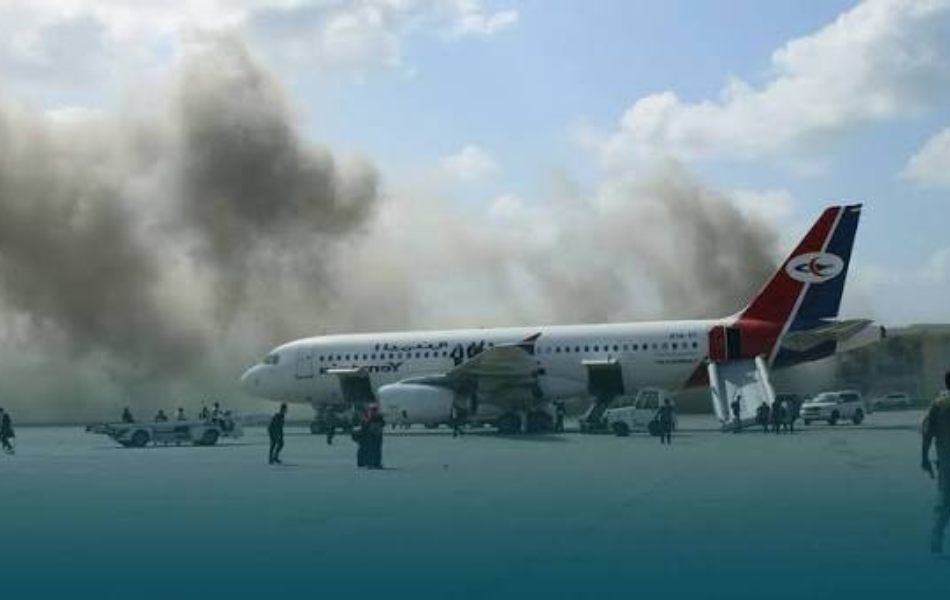
In the early hours of Wednesday, October 7, Aden International Airport came under attack involving two ballistic missiles and several drones. The attack was attributed to the Houthi group and occurred while the airport was handling civilian air traffic, with passengers, airport personnel, and flight crews present.
According to Yemen’s Ministry of Transport, the attack targeted the airport’s runway and passenger terminal. One of the missiles landed near the runway just minutes before the scheduled landing of a Yemenia Airways flight arriving from Cairo with civilian passengers on board. The attack forced the flight to be diverted, the airport terminal to be evacuated, and aircraft on the ground to be moved away from the area. Preliminary information indicated that no casualties were reported.
In a statement issued on October 7, SAM for Rights and Liberties condemned the attack on the airport, warning that a missile landing near the runway just minutes before a civilian aircraft was due to land demonstrated the extreme level of danger to which passengers, flight crews, and airport personnel had been exposed.
The organization stressed that civilian airports, runways, passenger terminals, and civilian aircraft are protected under international humanitarian law as civilian objects, emphasizing that the absence of casualties does not diminish the gravity of the attack or relieve those responsible of their legal obligations to protect civilians.
The incident is particularly serious given Aden International Airport’s vital role in civilian travel and the potential humanitarian and economic consequences of targeting or disrupting its operations, especially for patients, students, families, and other travelers.
On October 7, five civilians sustained injuries of varying severity following shelling that struck homes and residential areas in the Al-Thawra Hospital neighborhood and the Al-Shamasi area of Taiz city. The shelling was attributed to the Houthi group.
According to information published by Mohammed Taher, the injured were Shadhi Al-Bashiri (24), who sustained a shrapnel injury to his left shoulder; Ayman Ali Hazza (22), who suffered shrapnel injuries to his right forearm; Hamza Jamil Sharaf (23), who was injured by shrapnel in his left thigh; Yaqoub Mohammed Hussein (22), who sustained a shrapnel injury to his left hip; and Hussein Mohammed Hussein (20), who suffered shrapnel injuries to his right forearm.
The incident raises concerns about the continued exposure of residential neighborhoods and civilian families to the dangers of shelling, particularly when explosive weapons are used in populated areas. It underscores the need to investigate the nature of the targets and assess compliance with the rules of international humanitarian law.
On the evening of October 7, Mohammed Ghaleb Al-Ashab Al-Muraisi was killed and another civilian was injured when mortar shells struck inhabited agricultural areas in Al-Majanih subdistrict of the Murais area, Qatabah District, in northern Al-Dhalea Governorate.
According to Al-Masdar Online, citing local sources, the Houthi group carried out the shelling, killing the civilian and injuring another person, who was transferred for medical treatment.
The incident highlights the risks faced by civilians living in agricultural communities near frontlines and the threats that attacks on farmland and populated areas pose to human life, livelihoods, and local food security.
On October 7, journalist Fares Al-Humairi reported that residents had alerted him to a campaign of house raids and searches carried out by the Houthi group in the villages of Kahah, Al-Mashaar, and Dhi Al-Shahran in Jabal Habashi District, in rural Taiz Governorate.
Sufficient information was not available regarding the number of houses affected or the nature of the measures taken during the campaign. The legal grounds for the searches also remained unclear, as did whether the operations resulted in detentions or the confiscation of property.
These reports raise concerns about possible violations of the inviolability of homes and the right to privacy, particularly if the searches were conducted arbitrarily and without appropriate legal and procedural safeguards.
In a related development, Fares Al-Humairi published information on October 7 concerning raids and searches targeting the homes of three military commanders in different areas of rural Taiz.
According to the report, the targeted residences included the home of Brigadier General Abdulrahman Al-Shamsani, Commander of the 35th Armored Brigade, in Al-Ashrouh, Qadas; the home of Colonel Adel Al-Hammadi, Operations Chief of the 35th Armored Brigade, in Bani Hammad; and the home of Brigadier General Jamil Aqlan, Commander of the Special Security Forces, in Al-Mukaisha, Qadas.
No independently verified details were available regarding the circumstances of the raids or whether judicial warrants or other lawful authorizations had been issued for the searches. SAM emphasizes that the legal protections afforded to homes and private life are not automatically lost because of a homeowner’s official or military position, and that any search measures must comply with the law and applicable safeguards.
On October 8, Mohammed Al-Haidari reported that hundreds of members of the Houthi-affiliated female units known as the “Zainabiyat” had arrived in western rural Taiz, coinciding with a campaign to search homes and mobile phones.
No independent information was available to confirm the size of the force involved or the number of homes and devices searched. Nevertheless, the allegations raise serious concerns about the possibility of residents being subjected to arbitrary security measures affecting their privacy and personal security.
SAM stresses that searching mobile phones can expose private correspondence, photographs, personal data, and information concerning third parties. Arbitrary searches of such devices therefore constitute a particularly serious interference with the right to privacy and require strict adherence to the necessary legal safeguards.
Journalist Fares Al-Humairi, citing local sources, reported that the Houthi group had launched a widespread campaign in the city of Al-Turbah, Taiz Governorate, to confiscate Starlink satellite internet devices.
According to the published information, the campaign was part of broader efforts to restrict internet access and control the flow of information. However, independently verified details regarding the number of devices confiscated or the legal procedures underpinning the seizures were not available.
SAM warns that arbitrary confiscation of communication devices may deprive residents of essential means of communication and access to information, particularly in areas where telecommunications infrastructure is weak or conventional internet services are disrupted.
On October 8, Fares Al-Humairi reported complaints from users regarding an hours-long disruption of internet services provided by YemenNet, which operates under the administration of Houthi authorities, across extensive areas of Taiz Governorate. Users also reported noticeably slow internet speeds in the preceding days.
The immediate causes of the disruption remained unclear, including whether it resulted from technical failures or deliberate measures. No reliable information was available to establish a direct connection between the outage and the reported campaigns to confiscate alternative communication devices.
SAM emphasizes that prolonged internet disruptions or restrictions on access without a legitimate justification may directly undermine residents’ rights to communicate and obtain information. Such disruptions can also affect education, medical services, financial transactions, economic activities, and emergency communications.
On October 8, the International Committee of the Red Cross (ICRC) in Yemen announced that, since July 2026, it had received more than 1,800 tracing requests from families seeking information about the fate and whereabouts of missing loved ones, amid the latest escalation of hostilities in the country.
The ICRC noted that the escalation had caused immense suffering among many families and emphasized their right to know the fate and whereabouts of their relatives.
These figures highlight the growing humanitarian need to trace missing persons and restore family links. Not all tracing requests necessarily concern cases of enforced disappearance; nevertheless, they reflect the extent of the suffering experienced by families who have lost contact with their relatives or do not know where they are.
SAM for Rights and Liberties emphasizes that the convergence of these incidents reflects an alarming level of risk facing civilians in Yemen, whether as a result of armed attacks on residential areas and civilian facilities, security practices that interfere with the inviolability of homes and privacy, or potential restrictions on communication services and access to information.
The organization stresses that international humanitarian law prohibits attacks directed against civilians and civilian objects and requires parties to the conflict to distinguish between military objectives and civilian objects, respect the principle of proportionality, and take all feasible precautions to avoid or minimize civilian casualties and damage to civilian objects.
Regarding the attack on Aden International Airport, SAM considers that targeting a civil aviation facility while passengers and airport personnel were present and a civilian aircraft was approaching for landing raises serious concerns about compliance with the rules protecting civilians and civilian objects. It calls for an independent investigation into the nature of the targets, the means employed, and compliance with international humanitarian law.
Similarly, the shelling of residential neighborhoods and inhabited agricultural areas in Taiz and Al-Dhalea, which resulted in civilian deaths and injuries, requires an investigation into the circumstances of the attacks and the determination of legal responsibility for the harm inflicted on the affected populations.
With respect to house raids and searches, the organization emphasizes that the inviolability of homes and the right to privacy are protected under international human rights law. Any interference with private life, correspondence, or personal data must have a legitimate legal basis and must be necessary, proportionate, and non-arbitrary.
SAM further notes that access to the internet and communication services is an essential component of exercising freedom of expression and the right to seek and receive information. Deliberately disrupting services or confiscating communication devices without a legitimate legal basis may constitute a violation of these rights, in addition to causing humanitarian and economic harm to the population.
SAM for Rights and Liberties calls on the Houthi group to immediately cease attacks targeting civilians and civilian objects, refrain from any military operations that endanger civilian airports, residential neighborhoods, and inhabited agricultural areas, and strictly comply with the rules of international humanitarian law.
The organization also calls for independent and transparent investigations into the attack on Aden International Airport and the shelling incidents in Taiz and Al-Dhalea, including the documentation of casualties and damage, identification of those responsible for any violations, accountability, and effective remedies for victims and their families.
SAM further urges an end to arbitrary house raids and searches of mobile phones, disclosure of the legal grounds for the reported security measures, and guarantees that residents will not be subjected to violations of their privacy, dignity, or personal security.
It also demands an end to any arbitrary confiscation of communication devices, the continued availability of internet services, disclosure of the causes of the outages affecting Taiz Governorate, and appropriate measures to ensure residents’ access to information and essential services without unlawful restrictions.
In the humanitarian context, SAM calls on all parties to cooperate with the ICRC and relevant organizations to clarify the fate and whereabouts of missing persons, facilitate tracing efforts and the restoration of family links, and respect families’ right to know the fate of their loved ones.
The organization concludes by emphasizing that protecting civilians is not limited to preventing deaths and injuries. It also encompasses safeguarding personal security, the inviolability of homes, privacy, and the rights to communicate and access information. SAM calls for an end to all practices that compound the suffering of the population and undermine their fundamental rights amid the ongoing conflict.