

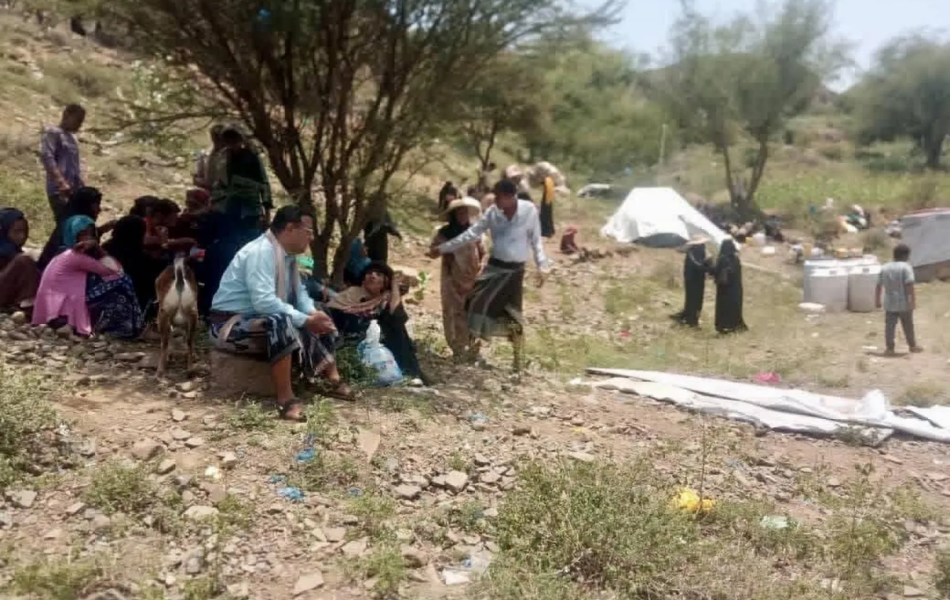
SAM for Rights and Liberties monitored a range of field, human rights, and humanitarian developments in Yemen between 23 September and 4 October 2026. A significant portion of these developments was concentrated in Taiz Governorate and its rural areas, amid continued waves of displacement from the western coast, the declining capacity of the health sector and humanitarian services to respond, and new reports concerning child recruitment, shelling of populated areas, home raids, and restrictions affecting displaced persons and humanitarian workers. Pasted markdown
Available information indicates that the escalation that began in previous weeks did not subside during the period covered by this briefing. Rather, it expanded into new areas of Taiz, particularly Al-Dhabab, Al-Shaqab, Bani Bakari, Al-Shamayatayn, Jabal Habashi, Samea, and Al-Misrakh, while displacement figures continued to rise rapidly. At the same time, significant disparities remained between figures reported by international organizations and government bodies due to differences in monitoring and registration methodologies and geographical coverage.
On 23 September, Al-Masdar Online reported that Salim Al-Sarhani, a resident of Al-Sharyah District in Al-Bayda Governorate, accused a Houthi-affiliated supervisor named Ahmed Ali Al-Ansi of taking his 13-year-old son, Saeed, without the family’s knowledge for the purpose of recruiting him and sending him to the front lines. The father said contact with the child was lost after he was taken and that he later received information indicating that Saeed had been transferred to Sana’a. He also alleged that another individual had participated in taking children from their families. No independent information is available in the published material establishing the child’s whereabouts or fate. SAM therefore presents the case as a family complaint requiring urgent investigation, rather than as definitive proof of individual responsibility on the part of the named persons.
On the same day, a video recording was published showing an 18-year-old young man who had been captured by the Giants Brigades on the Kahbub front. He said he had spent one month at a summer center before being told that he would be taken to Mokha on a trip to the sea. He was then given a weapon and ammunition and transferred directly to the front line. As the young man stated that he was 18 years old, his case is not itself classified as child recruitment. It nevertheless provides an indication warranting investigation into recruitment pathways that begin with summer activities or activities presented as civilian or recreational and ultimately lead to arming individuals and transferring them to combat positions.
Also on 23 September, journalist Fathi Bin Lazrq published an account concerning a mother from Dhamar Governorate who said her son, whom she estimated to be between 14 and 15 years old, had initially been taken to participate in a cultural course accompanied by food assistance. Contact with him later ceased, before she learned, according to her account, that he was among a group transferred toward Taiz and Mokha. Insufficient information is available regarding the child’s identity, location, or the party that transferred him. The case therefore remains an indicator requiring follow-up and, in its current form, is insufficient to establish the details of the alleged recruitment process.
In the same context, the Minister of Human Rights in the Yemeni government announced on 23 September that more than 4,700 children had been recruited and killed in Houthi ranks since 2015, stating that the figure covered cases the relevant authorities had been able to document. SAM presents this figure as a cumulative government total that does not relate solely to the current reporting period and does not combine it with the individual cases contained in this briefing, given the absence of a list of names that would allow cross-checking and the prevention of duplication.
SAM for Rights and Liberties obtained field information concerning the killing of civilian Hamoud Abdullah Saif Al-Rajhi inside his home in the Al-Salaf area of Samea District, southern Taiz Governorate, on Friday, 2 October 2026, in an incident attributed to elements affiliated with the Houthi group.
According to information received by the organization, the incident was preceded by arguments between Al-Rajhi and members of the group after he refused to allow his home to be converted into a position for use by snipers. The information indicates that armed elements subsequently stormed the house by force and opened fire on Al-Rajhi inside the home, killing him.
Preliminary information obtained by SAM indicates that the incident took place in the context of an armed deployment and a campaign of home raids in the Al-Salaf area that had begun on the previous Thursday evening and affected a number of residents’ homes.
If the circumstances of the killing are established as described in the information received by SAM, the incident raises serious concerns regarding the deliberate killing of a civilian, contrary to the protections afforded under international humanitarian law to civilians and persons not directly participating in hostilities.
In a related development, SAM obtained information concerning a campaign of raids carried out by Houthi-affiliated elements on residents’ homes in the villages of Al-Madhabah and Waq’an, in Uzlat Al-Jabal, Samea District. According to information received by the organization, the campaign resulted in the arrest of Mohammad Ahmed Abdu and Hazza Abdullah Naji.
At the time of preparing this briefing, insufficient information was available regarding their place of detention, the legal basis for their arrest, or whether they had been able to contact their families or access legal safeguards. SAM stresses the need to disclose their whereabouts and the reasons for their detention, ensure that they are treated humanely, and enable them to exercise the fundamental rights and safeguards associated with detention.
On the evening of 24 September, journalist Mohammed Taher reported that a child was killed and five civilians were injured when a projectile struck the Wadi Al-Qadi neighborhood in central Taiz city. The source attributed the shelling to the Houthi group.
The available material does not provide the names of the victims or the ages of those injured, nor does it contain technical information concerning the type of projectile, its trajectory, or its point of origin. The casualty toll and attribution of responsibility therefore require further field and technical verification.
On 24 September, a local source reported that three explosive devices disguised as stones had been discovered and dismantled in Madhafah village in the Bani Bakari area. The source attributed their placement to the Houthi group.
According to the available information, no injuries resulted from these devices. However, the presence of disguised explosive devices in a civilian environment poses particular risks to residents, especially children, shepherds, and passersby, because of the difficulty of distinguishing them from naturally occurring objects.
On 25 September, the Yemen Petroleum Company in Sana’a said that a Saudi airstrike had targeted a fuel station used to supply fishermen’s boats on Kamaran Island in Al-Hodeidah Governorate, describing the facility as civilian and directly linked to fishermen’s livelihoods.
The available material does not contain an independent source confirming the strike or establishing the nature of the facility’s use at the time of the attack, and no casualty toll was reported. SAM therefore presents the allegation as attributed to the party that issued it and stresses that determining whether the facility constituted a civilian object or a military objective requires examining its actual use at the time of the attack and any concrete military advantage expected from targeting it.
On 27 September, Al-Masdar Online cited residents as saying that villages in the Al-Dhabab area west of Taiz had been struck by more than six shells reportedly fired from positions in Al-Ruba’i. The source did not report casualties or damage.
On 28 September, journalist Mohammed Taher reported that villages in Al-Shaqab, southeast of Taiz, had been struck by ten mortar shells. The following day, he published a new report concerning continued shelling of villages in the area. The available material did not report casualties in either incident.
Also on 28 September, journalist Fares Al-Humairi reported shelling that struck a number of residential neighborhoods in Taiz city, coinciding with the arrival of Houthi military reinforcements in several areas of the governorate. The published material does not provide details concerning the number of projectiles, precise impact locations, or human and material losses. The incident therefore requires further documentation.
On 29 September, a local source reported that villages in the Bani Bakari area of Jabal Habashi had been subjected to tank and mortar shelling from positions near the villages of Al-Qawz, attributing the shelling to the Houthi group.
Further reports on 1 October indicated renewed tank and artillery shelling of the area following intense clashes that had begun in the early morning hours between army and resistance forces and Houthi fighters.
The available information does not provide a specific civilian casualty toll or sufficient details regarding impact locations. However, the repeated use of weapons with wide-area effects near residential villages warrants verification of the military objectives present in the area and the extent to which precautions were taken to avoid harm to civilians and their property.
On 29 September, journalist Fares Al-Humairi said that three ballistic missiles attributed to the Houthi group targeted Al-Turbah city, one of which struck a maternity and children’s hospital building that was still under construction, causing material damage. The report did not indicate any casualties, and no independent technical information is available regarding the missiles’ trajectories, launch points, or intended targets.
Even while under construction, the hospital building remains a civilian object unless, under the circumstances prevailing at the time of the attack, it was being used in a manner meeting the criteria for a military objective. If the building was intended for medical purposes, its civilian character and the special protection afforded to medical facilities reinforce the need for particular scrutiny of the circumstances surrounding the attack.
On 30 September, Mohammed Taher and Ahmed Al-Bakari reported that 15-year-old Youssef Abdulwarith Karami was killed and 29-year-old Awatif Abdullah sustained shrapnel wounds to different parts of her body after a house in the Salah area, east of Taiz city, was shelled. Both sources attributed the shelling to the Houthi group.
This is one of the few incidents during the reporting period for which the names and ages of victims are available. Nevertheless, the available material does not contain technical information sufficient to independently establish the type or origin of the projectile.
On the same day, Mohammed Taher and Ahmed Al-Bakari reported that 23 shells had been fired toward the villages of Al-Dhabab, Al-Sayahi, Hadharan, and Milat west of Taiz city. The reports attributed the firing positions to locations in Al-Ruba’i and Hadharan.
The available material contains no casualty toll. However, the intensity of shelling across an area containing several populated villages requires documentation of impact points and damage, verification of whether legitimate military objectives were present in the targeted areas, and an assessment of the type and accuracy of the weapons used and their suitability for use in a civilian environment.
On 27 September, Fares Al-Humairi published information alleging that the Houthis had introduced their own curricula in schools in areas under their control on the western coast, in Al-Hodeidah, and in western Taiz. He also said that students and families in Sana’a had been asked to donate old school textbooks to address shortages in schools on the western coast, and that envelopes had been distributed to schoolchildren to collect money reportedly intended to support the drone air force.
These claims require independent verification from the schools concerned, including examination of the relevant directives, the authorities that issued them, and the manner in which funds were collected and used. If schools and children were indeed used to collect resources directly intended for military activities, this would raise concerns regarding the politicization of the educational environment and the involvement of children in activities linked to the armed conflict.
On 1 October, Fares Al-Humairi reported that simultaneous attacks, accompanied by heavy fire including missile and artillery shelling, targeted residential areas and communities hosting displaced persons in the districts of Al-Shamayatayn, Jabal Habashi, Al-Misrakh, and Samea in rural Taiz.
The same source also reported that Houthi gunmen had entered several villages, including three villages in Al-Shamayatayn, two in Jabal Habashi, as well as areas in Al-Aqrudh and Samea. He said that in one village a medium weapon had been positioned inside the courtyard of a house and used to fire toward locations within the village. The currently available material does not provide independent information identifying every village or allowing verification of the military use of each home or location mentioned.
On the same day, the source reported raids on homes in the Al-Salaf area of Samea District several hours after Houthi gunmen entered the village. The material does not state how many homes were raided, identify their owners, or clarify whether the raids were accompanied by arrests or the confiscation of property. These elements therefore require additional documentation.
On 1 October, Fares Al-Humairi reported that Houthi gunmen blew up a main culvert in the Najd Al-Bard area below the Hayjat Al-Abd road using explosive devices and other explosives. According to the source, the explosion cut the main road linking Taiz city and districts of the governorate with Aden.
The source added that several residents attempted to prevent the culvert from being destroyed and that the gunmen attacked them, killing one civilian and injuring others. The names of the person killed and those injured were not available.
The incident carries additional humanitarian significance because the road is used for civilian movement, supplies, and medical referrals. Assessing the legality of targeting the structure requires verification of its actual military function at the time of destruction, the specific military advantage anticipated from disabling it, and the expected impact on civilians, transportation, and humanitarian assistance.
On 3 October, Hamdi Al-Samei published information concerning mortar shelling of villages in Uzlat Shurai’ in Samea District. In another post, he said that some villages in the district were experiencing displacement for the first time in approximately 11 years because of continued shelling of homes.
On 3 October, Fares Al-Humairi said he had received reports and complaints from residents of Al-Shamayatayn and Jabal Habashi concerning searches of homes and intimidation of women and children in villages entered by Houthi forces.
The published information does not include a list of affected persons or homes and does not clarify the nature of the searches or whether they were accompanied by seizures or arrests. These reports therefore require case-by-case documentation, while witnesses and affected families should be protected from retaliation.
On 4 October, the same source reported the beginning of a large wave of displacement from populated areas and villages in Al-Shamayatayn District following the entry of Houthi elements. No precise figure is yet available for the number of persons displaced in this wave or their destinations. These movements therefore require independent monitoring and should not be automatically added to earlier cumulative displacement totals.
On 25 September, UNICEF said it had verified that, since 3 September, at least 15 children had been killed and 14 injured, while three others remained reported missing.
UNICEF added that 243 schools had closed or suspended learning, affecting more than 137,000 students. These figures represent cases that UNICEF was able to verify or monitor according to its methodology and should not be combined with other local casualty figures without cross-checking individual cases.
UNICEF also said its mobile nutrition teams screened approximately 2,900 children in areas where safe access was possible and found that more than one in four were acutely malnourished, including more than 200 children suffering from severe acute malnutrition.
Even before the latest escalation, more than 2.2 million children under the age of five were projected to suffer from acute malnutrition in 2026, including more than half a million suffering from its most severe form.
In a report published on 24 September, the Executive Unit for the Management of IDP Camps said its data, updated through 23 September, recorded 27,413 displaced families comprising 180,513 people across ten governorates, including 93,917 people in Taiz, which ranked first among host governorates.
In a subsequent update, the Unit said the total had risen by 27 September to 27,834 families comprising 186,144 people. On 30 September, it announced that the total had risen to 29,519 families comprising 197,906 people, based on field updates extending through 28 September, while Al-Hodeidah data remained based on an earlier update.
In a statement published on 3 October, the Unit said monitoring data through 30 September showed 29,506 families comprising 197,945 displaced persons. This figure differs slightly from its 30 September update, and the two should therefore be treated as separate administrative updates issued by the same source rather than independent totals that can be combined.
By contrast, the International Organization for Migration reported that, as of 28 September, 145,308 people, representing 24,218 families, had been displaced across eight governorates, an increase of 15,870 people in one week, or more than 12 percent.
Taiz hosted 81,444 displaced persons, followed by Lahj with 34,860, Aden with 12,456, Al-Hodeidah with 8,244, Abyan with 5,568, followed by Hadramout, Marib, and Al-Mahrah.
IOM said Aden recorded an increase of nearly 40 percent in the number of displaced persons over the course of one week, reflecting the growing movement of families toward urban areas and the resulting pressure on housing, services, and livelihoods.
Differences between figures issued by IOM and the Executive Unit do not necessarily constitute a contradiction. The organizations differ in their definitions of recorded displacement movements, geographical coverage, verification mechanisms, and update schedules. Their figures should therefore not be combined or used to correct one another without reference to each organization’s methodology.
UNICEF said on 25 September that some families had been displaced as many as six times and that approximately 130,000 people, including an estimated 71,000 children, had been forced from their homes over the previous three weeks, most of them in southwestern Yemen.
The organization published testimonies from families who said they had fled under gunfire and shelling and had been able to take only a limited number of basic belongings with them.
In material published on 1 October under the title “We Fled in the Dark: A Mother’s Search for Safety in Yemen”, UNICEF said more than 145,000 people had been displaced between 3 and 28 September, including an estimated 79,000 children.
The material highlighted the case of Taghreed, a mother of nine from Al-Kadhah, who said she had been forced to flee at night while bullets passed overhead and shells fell nearby. She and her children are now living at a displacement site in Jabal Habashi, where, like other families, they face limited access to clean water, health care, and basic services.
UNICEF also said on 28 September that around 1,750 people had taken shelter at the Al-Firdaws displacement site in Aden and that some families there had already been displaced three or four times.
In another testimony published on 25 September, a woman named Asmaa from Al-Firdaws camp described being displaced for a second time. She said her family had fled at night without adequate clothing or belongings and needed cooking utensils, drinking water, cooling equipment, and fuel.
On 28 September, the International Organization for Migration published the story of Ahmed’s family. Ahmed, 64, said he had been displaced four times. According to his account, his family walked for approximately 17 hours after leaving Al-Khawkhah, then continued from Aden to Marib on another 36-hour journey before reaching the Rumaylah Al-Qawz displacement site, where they became dependent on assistance after losing their home and source of income.
On 27 September, the United Nations Population Fund published testimonies from displaced women who said they sometimes delayed using toilets because they did not feel safe, and described overcrowding and a lack of privacy, particularly for pregnant women.
These testimonies highlight protection risks that are not limited to shelling or displacement itself, but also relate to the design of displacement sites and the availability of separate, safe, well-lit, and appropriate facilities for women and girls.
In an update published on 1 October, UNFPA said more than 145,000 people had been displaced since the beginning of September and that continued fighting had disrupted reproductive health services and protection services for women in several affected areas, with a number of health facilities and safe spaces for women and girls remaining closed.
UNFPA added that the inter-agency Rapid Response Mechanism it leads had provided emergency assistance to more than 92,000 people as of 28 September, while warning of a funding gap of USD 22.7 million required to expand the response through the end of the year.
On 30 September, Al-Masdar Online published a report concerning an institutional dispute between government and local bodies over the management of displacement in Aden, stating that the dispute had affected registration, access to displaced families, and aid coordination.
According to the report, the leadership of the Executive Unit recorded 19 incidents during September, including the detention and questioning of one of its field representatives, summonses issued to several female representatives, the detention of field representatives and restrictions preventing them from continuing registration and follow-up activities, as well as the removal of approved camp representatives and their replacement with others.
The report did not specify the date of each individual incident, and it therefore cannot be assumed that all 19 incidents occurred between 23 and 30 September. However, on 28 September, the leadership of the Executive Unit issued a directive suspending the work of its field team and volunteers in Aden until the dispute was addressed and the team’s safety was guaranteed.
The report also referred to a local circular requiring prior authorization before newly arriving families could be accommodated in displacement camps, as well as complaints concerning interference in the work of field representatives and in the movement of aid.
SAM recognizes the authorities’ right to adopt lawful security and administrative measures. Such measures, however, must not become an obstacle to registering displaced families, providing them with shelter, or enabling them to receive assistance, nor should they result in discrimination against displaced persons on the basis of their place of origin or geographical identity.
The report published on 30 September also raised questions regarding the Al-Firdaws site in the Salah Al-Din area of Al-Buraiqa, which has been used to accommodate some newly displaced families.
It referred to an assessment conducted in 2022 that classified the site at the time as unsuitable because of concerns relating to water, land ownership, and protection, in addition to the presence of a confirmed minefield approximately five kilometers away at that time.
The earlier assessment does not mean that these risks necessarily remain unchanged in 2026. However, renewed use of the site makes it important to establish whether the relevant authorities have conducted an updated assessment addressing safety, water and sanitation, protection, and access to schools, health facilities, markets, and livelihood opportunities.
On 23 September, the World Health Organization said more than 122,000 people had been displaced across eight governorates and that 3,672 casualties had been reported between 6 August and 18 September, including 674 deaths and 2,998 injuries. Of these, 680 new casualties were recorded between 13 and 18 September alone.
WHO said Marib had recorded 1,690 casualties, followed by Taiz and the western coast with 1,349, while Lahj recorded 284 casualties during the latest reporting period.
The organization said approximately 60 percent of 5,415 assessed health service delivery units were fully functional, 35 percent were partially functional, and 4 percent were non-functional, while comprehensive trauma care was available in only 6 percent of assessed facilities.
WHO also warned that displacement, overcrowding, and disruption of essential services increase the risks associated with cholera, acute watery diarrhea, measles, dengue fever, diphtheria, and malnutrition.
In an update published on 29 September, the World Health Organization through the United Nations warned that the escalation was pushing Yemen’s already fragile health system toward the brink of collapse. It said data from the Ministry of Health in Aden showed that the cumulative toll since 6 August had risen to 4,481 casualties, including more than 830 deaths.
WHO said comprehensive emergency obstetric and newborn care had been suspended in two hospitals in Marib and Ras Al-Arah after staff and operational capacity were redirected to trauma care, while nine health facilities or health assets had been damaged or put out of service, mostly in areas around Taiz, Lahj, and Al-Hodeidah.
The organization added that its stocks were nearly depleted and that approximately USD 9 million was needed for its health response, while only around USD 2 million had been secured at that time.
The movement of Yemenis by sea to Djibouti continued during the reporting period alongside increasing internal displacement. The World Health Organization, in a UN briefing, said more than 3,600 Yemenis had arrived in Djibouti since 10 September and that nearly half of them were children, amid growing pressure on reception sites and essential services.
This movement is directly linked to deteriorating security along the western coast and repeated displacement. However, it does not necessarily constitute a safe alternative, given the risks associated with the sea journey, limited reception capacity, and inadequate humanitarian funding at arrival sites.
The incidents recorded between 23 September and 4 October indicate the continued spread of military operations into populated areas and villages, with repeated use of mortars, artillery, and missiles near homes, hospitals, roads, and communities hosting displaced persons.
The mere fact that a projectile falls in a civilian area does not, by itself, establish a violation of international humanitarian law. Such an assessment requires determining the intended target, the nature of the weapon used, the location of forces and military positions, the expected civilian harm, and the precautions taken by the attacking party.
However, the recurrence of incidents in populated neighborhoods and villages, coupled with civilian deaths and injuries, including among children, warrants independent investigation into compliance with the principles of distinction, proportionality, and precautions in attack.
Homes, schools, hospitals, economic facilities, and roads are presumed to be civilian objects and may not be targeted unless, in the specific circumstances of the incident, they satisfy the criteria for a military objective. Medical facilities enjoy special protection and lose that protection only under narrowly defined legal circumstances, while the obligations of proportionality and precautions continue to apply in all cases.
If confirmed, the destruction of the culvert in Najd Al-Bard raises concerns regarding its impact on civilian movement, medical referrals, and humanitarian assistance. The explosive devices disguised as stones in Bani Bakari likewise pose a potentially long-term threat to residents even after direct hostilities have ended.
With regard to children, reports concerning a 13-year-old child and other children who may have been transferred away from their families to camps or front lines require urgent investigation to establish their whereabouts and ensure their safety. Additional Protocol II prohibits the recruitment or use in hostilities of children under the age of 15, while the Optional Protocol to the Convention on the Rights of the Child provides broader protection in relation to the recruitment of persons under 18 by armed groups.
The use of schools, summer centers, or ostensibly civilian activities as possible pathways for military recruitment, if established, threatens the civilian character of education and exposes children to pressure and exploitation inconsistent with their rights to protection and education.
With regard to displacement, not every flight from fighting automatically constitutes unlawful forced displacement. However, continued shelling of villages, the entry of armed forces into residential areas, raids, and the destruction of roads and transit infrastructure are all factors that must be examined to determine whether populations are being compelled to leave in circumstances inconsistent with the restrictions international humanitarian law places on conflict-related displacement.
Humanitarian data further shows that the effects of conflict do not end once families reach comparatively safer areas. Risks then shift to inadequate shelter, food, water, and health care, lack of privacy, disrupted education, malnutrition, and wider protection concerns, particularly for women, children, and persons who have already experienced repeated displacement.
The period from 23 September to 4 October reveals a continuing and complex pattern of harm: repeated shelling of populated areas in Taiz and its countryside, civilian deaths and injuries including among children, allegations of child and youth recruitment and military mobilization, the entry into and raiding of villages and homes, disruption of key roads, and continued displacement that exceeded 197,000 people according to some government sources, while the International Organization for Migration recorded more than 145,000 displaced persons under its own geographical scope and methodology.
These figures should not be added together or assumed to describe the same population, and not all allegations contained in local sources can be regarded as having been established to the same evidentiary standard.
SAM stresses the need to continue field and technical verification of the incidents contained in this briefing; document victims by name and age; preserve medical records, photographs, munition remnants, and location data; investigate the circumstances in which civilians were killed and weapons were used in populated areas; establish the fate of missing and recruited children; ensure that displaced persons have access to registration, shelter, and assistance without discrimination or obstruction; and enable humanitarian workers to carry out their duties safely and independently.